


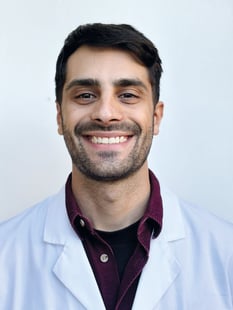
Kirey’s commitment to supporting scientific research on women’s cancers alongside the Fondazione Umberto Veronesi continues in 2026 through a research grant designed to support the work of Alfredo Smiriglia, a postdoctoral researcher at the University of Florence.
His project focuses on the study of ER+ breast cancer, with the objective of investigating some biological mechanisms that may influence therapy response and the development of resistance over time.
We asked him a few questions to explore his background and the main objectives of his research.
If you had to introduce yourself in a few lines, how would you describe your background? What studies and experiences brought you here?
My name is Alfredo Smiriglia and I am a post-PhD researcher at the Fondazione Veronesi in the “Mario Serio” Department of Biomedical, Experimental, and Clinical Sciences at the University of Florence, in Professor Andrea Morandi’s laboratory. I come from Calabria and moved to Florence for my Bachelor’s degree in Medical-Diagnostic Biotechnology. I then continued with a Master’s degree in Medical and Pharmaceutical Biotechnology, and finally completed my PhD in 2024.
During my PhD, I had the opportunity to spend time in Barcelona in an international laboratory. It was an experience that shaped me not only scientifically but also personally, because it allowed me to learn how to work in a multicultural environment, to engage with different approaches to scientific problems, and to understand that science is truly a universal language. I participated in international conferences, published in journals, and now, with the support of Fondazione Veronesi, I continue to do what I love: looking for answers to questions that still have no answers.
How did you choose this research topic? What are the main objectives of the project and what impact do you think it may have on patients’ lives?
The choice of topic was not random: it originated from the meeting between an unresolved clinical question and a fascinating biological context. Breast cancer is the most common cancer in women and one of the leading causes of cancer-related death worldwide. The most common form, ER-positive breast cancer, which expresses the estrogen receptor, is treated with hormone therapies that block the production or action of estrogens. These therapies work very well, but over time many patients develop resistance: the tumor finds a way to continue growing even without estrogens. This is where the success story of therapy breaks down.
The question guiding my work is: why does this happen and how can we counteract it? In our laboratory, we discovered that tumor cells resistant to hormone therapy seem to depend on an enzyme called CYP1A1, which is involved in cholesterol metabolism. In practice, these cells use cholesterol derivatives as substitutes for estrogens to continue activating the estrogen receptor and proliferate. It is an elegant and insidious adaptation mechanism. The goal of my project is to understand exactly how this mechanism works and to demonstrate that inhibiting CYP1A1, alone or in combination with existing drugs, can block this escape route of tumor cells.
The potential impact for patients is concrete: if we can validate CYP1A1 as a therapeutic target, we can open the way to developing new strategies for patients who have developed resistance to hormone therapy, for whom therapeutic options are still limited today. It is not an immediate goal, but it is the kind of basic research that, over time, fuels clinical innovation.
In your daily work, what is the most complex part and what excites you the most?
The most complex part is undoubtedly managing uncertainty. In the lab, most experiments do not work as expected. I do not mean that they fail, but that results are often ambiguous, unexpected, and difficult to interpret. You have to learn to distinguish a technical artifact from a biologically meaningful result, and that is not always immediate.
But then there is the other side. The moment when you look at the data from an experiment and see something unexpected, something that has never been observed before: it is an unmatched feeling. It is often just a graph on a screen, at the end of the day, perhaps after weeks of attempts. But in that moment you understand why you do this work. Every small discovery is a window opening onto something unknown, and that feeling never fades.
I would add a third element that excites me greatly: working with young, curious, passionate people. The laboratory is a community. Science is done together, not alone, and this aspect allows me to share ideas, exchange perspectives, and support each other in difficult moments. It is something I did not expect when I started, but it has become one of the deepest values of my daily work.
Do you think the business world is sufficiently involved in scientific research? What message would you give to those who choose to support it?
The involvement of companies in scientific research has grown in recent years, but there is still a significant gap, especially in Italy, between academia and the business world. Large pharmaceutical companies invest in applied research, in the later stages of drug development. But basic research — the kind that studies the fundamental mechanisms of cancer biology, which is also what I work on — largely depends on public funding and private foundations such as Fondazione Veronesi. The issue is that basic research does not provide immediate and measurable economic returns.
The message I would give to those who choose to support scientific research is this: you are investing in the future. Perhaps not in your immediate future, but in the future of your children, your grandchildren, and the people around you. Every drug that saves lives today is the result of basic research carried out decades ago by someone who did not know where their work would lead. Supporting research today means that in twenty years there will be therapies that do not exist today.
What role has the Foundation’s support played in your career? How has it influenced your work and your opportunities?
The support of Fondazione Veronesi has had an impact that goes far beyond the funding itself, although that is already extremely important.
The post-doc scholarship I received for 2026 allowed me to continue working on CYP1A1 and hormone therapy resistance at a time when many young researchers face a difficult choice: continuing to pursue an academic career in Italy, often with limited stability and resources, or seeking opportunities abroad or in other sectors. Receiving competitive funding awarded based on the scientific merit of the project is an important signal, meaning that your work has been positively evaluated by an independent panel of experts. This has enormous value for self-confidence, as well as for career development.
But there is one aspect I perhaps appreciate even more: Fondazione Veronesi strongly believes in science communication. Projects such as “Researchers in the classroom” have brought me into schools to talk about cancer and research with 16–18-year-old students, and this experience moved me deeply. I learned how to explain my work in a simple way, to listen to questions from those without a scientific background, and to remember why what I do has a meaning that goes beyond the numbers of a publication. Scientific communication is not an ancillary activity, but an integral part of the contract that science has with society. And Fondazione Veronesi has taught me this by example.